
An In-Depth Commercial and Technical Guide to High-Durability Monofilament Hair Replacement Systems
Executive Summary & Industry Overview
In the non-surgical hair replacement industry, selecting the ideal hair system requires a direct balance between three critical factors: durability, natural appearance, and wearing comfort. While ultra-thin skin and delicate lace hair patches focus heavily on achieving invisible hairlines, they sacrifice structural integrity and lifespan.
Regular Hair Mono (RHM) systems—frequently referred to in retail and manufacturing settings as Mono Welded Hair Patches (MWHP)—represent the ultimate solution for high-durability requirements. Engineered with a reinforced woven monofilament mesh core and tough Polyurethane (PU) perimeter borders, RHM/MWHP hair systems are designed to withstand heavy density, active lifestyles, daily friction, and extended wear.
Key Takeaway for Retailers & SEO Writers:
While some technical specs differentiate standard monofilament from heat-welded mesh, in customer-facing retail, Regular Hair Mono (RHM) and Mono Welded Hair Patch (MWHP) refer to the same unified category of heavy-duty, long-lasting monofilament hair replacement units.
Understanding Base Construction & Technical Specs
The core strength of a Regular Hair Mono / Mono Welded Hair Patch stems from its hybrid structural engineering. Unlike single-material bases, an RHM patch combines high-tensile synthetic mesh with flexible polymer reinforcement.
1. Heat-Welded Monofilament Core
The primary crown and top section of the patch are constructed from fine monofilament synthetic threads. In welded mono bases, the thread intersections are heat-sealed together. This process prevents individual grid lines from shifting, fraying, or loosening when hair strands are double-knotted into the mesh. It provides a solid foundation capable of supporting heavy hair volume without base deformation.
2. Reinforced Polyurethane (PU) Border
Surrounding the delicate central monofilament core is a thick perimeter coating of Polyurethane (PU) or NPU (Net PU). This smooth outer ring serves two vital functions:
Adhesive Stability: Provides an easy-to-clean, non-porous surface specifically designed for double-sided hair system tapes and liquid adhesives.
Structural Protection: Absorbs tension during removal, preventing the central monofilament mesh from tearing along the edges.
3. High Hair Density Capability
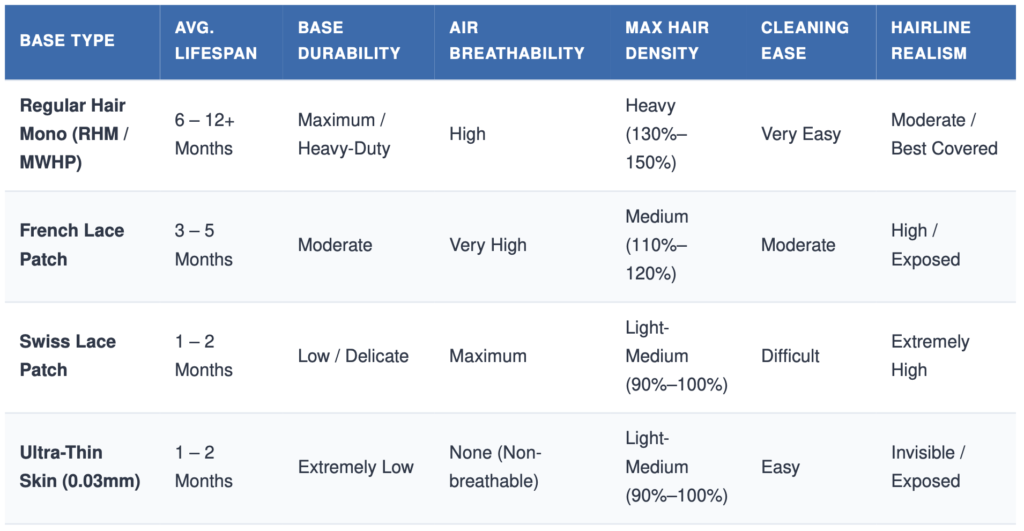
Delicate French or Swiss lace can rip when loaded with thick hair. Monofilament welded bases comfortably support Medium-Heavy to Heavy density levels (130% to 150%+) without stretching or thinning out over time.
Primary Benefits of RHM / Mono Welded Hair Patches
1. Extended Operational Lifespan
The single biggest advantage of an RHM / MWHP system is longevity. Where thin skin units last 1–2 months and lace systems last 3–5 months, a well-maintained mono-welded hair patch routinely lasts between 6 to 12+ months. This makes it the most cost-effective option on the market.
2. Unmatched Density & Volume Support
For wearers who desire full, voluminous hair styles rather than sparse or thin hair coverage, mono systems provide the heavy-duty foundation needed to anchor high strand counts securely.
3. Easy Cleaning and Maintenance
Adhesive residues often seep deep into multi-strand lace weaves, requiring lengthy soaking and scrubbing. In contrast, the firm mono grid paired with the solid PU border enables rapid tape peeling, easy solvent cleanup, and reduced maintenance time.
Comprehensive Base Material Comparison
Potential Downsides & Customer Considerations
While mono hair systems offer superior strength, transparency regarding their limitations builds customer trust and improves conversion:
Base Firmness & Initial Scalp Sensation
Because monofilament synthetic threads are stiffer than soft lace threads, new wearers may experience slight friction against the scalp during the initial break-in period. Utilizing a liquid scalp barrier spray creates a protective shield, minimizing potential irritation.
Hairline Styling & Coverage
The reinforced front border of a mono patch is slightly thicker than paper-thin lace or skin. For optimal realism, stylists recommend hairstyles that drop hair forward or downward over the hairline (e.g., fringe, comb-over, side-part, or textured crop) rather than slicked-back or exposed styles.
Maintenance Guidelines to Maximize System Lifespan
Always Use Adhesive Solvents: Never peel tapes dry. Apply citrus-based or C-22 solvent along the PU border to release tape bonds smoothly without straining knots.
Wash with Hydrating, Sulfate-Free Products: Mono knots benefit from gentle washing. Use alcohol-free shampoos and leave-in conditioners to keep the human hair soft and resilient.
Control Blow-Dryer Heat: Excessive heat can weaken the heat-welded joints in the mono base and warp the PU border. Always use cool or lukewarm air settings.
Apply Scalp Barrier Protectors: A scalp shield spray stops natural oils and sweat from breaking down base adhesives prematurely, preserving base cleanliness.
SEO Optimization Module: Metadata & Keywords
Target Primary & Secondary Keywords
Regular Hair Mono, RHM hair system, Mono Welded Hair Patch, MWHP hair toupee, monofilament hair patch, durable hair system, long lasting hair patch for men, PU border mono patch.
Frequently Asked Questions (People Also Ask)
Q1: How long does a Regular Hair Mono (RHM) hair patch last?
A: With proper cleaning and maintenance, a Regular Hair Mono / Mono Welded system typically lasts between 6 to 12 months (and often up to 18 months), significantly outlasting fine lace or skin systems.
Q2: Are Regular Hair Mono and Mono Welded Hair Patches the same thing?
A: Yes, in general hair system retail, RHM and MWHP are used synonymously to describe monofilament hair replacement units featuring welded mesh centers and polyurethane (PU) outer borders.
Q3: Can I wear a Regular Hair Mono system while swimming or playing sports?
A: Absolutely. Monofilament mesh is breathable, allowing heat and water to pass through, while the sturdy PU border holds waterproof tapes securely in place during vigorous activities.
Q4: How do I prevent scalp irritation with a mono hair patch?
A: Apply a liquid scalp protector before mounting the system with tape or glue. This creates a barrier between your skin and the mesh, reducing friction and preventing sweat-induced itching.
Q5: What hair density is best suited for an RHM patch?
A: RHM and MWHP bases are best suited for Medium to Heavy hair density levels (130% to 150%). Their strong monofilament structure prevents the base from tearing or sagging under heavy hair volume.
Leave a Reply